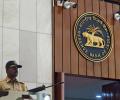
RBI Governor Raghuram Rajan asked banks to follow suit and pass on the rate cuts.

Sensex in green, JSW climbs higher.

After last Monday's massive fall in the Indian markets, a lot of quality stocks have fallen significantly.

At 15.05 PM, the 30-share Sensex was up 281 points at 28,238 and the 50-share Nifty gained 86 points at 8,577

Customers can link their cards to banks' app and make payments after scanning a 'quick response' code.

Power, oil and gas, PSU, metal, banking, auto, capital goods, infrastructure and healthcare sector stocks witnessed heavy buying through the session.

In the aftermath of the Karvy incident, lending against third-party collateral facility raises questions over regulations concerning banks and brokers which are at loggerheads. While Sebi and NSDL have ordered the transfer of securities, which were kept as collateral, lenders followed the old business model of sanctioning loan against shares and allegedly overlooked certain parameters. Legal experts feel that this could lead to a collapse of the loan-against-shares market as it raises questions over the sanctity of the pledged securities.

A recovery in rupee, buying by domestic institutional investors, encouraging earnings by select blue-chips and stock specific buying helped the market get back on its feet

The NSE 50-share after moving between 10,309.85 and 10,261.50 on alternate bouts of selling and buying, finished at 10,298.75, with paltry gains of 15.15 points, or 0.15 per cent.

Calling out the high real interest rates -- the differential between the policy rate and headline inflation -- as an impediment to investment, the SBI report said the RBI can cut rates by 0.35-0.50 per cent at its next policy announcement.

YES Bank raises base rate; HDFC Bank, Axis hike deposit rates.

HCL Tech was the top gainer in the Sensex pack, rising over 4 per cent, followed by HDFC Bank, Infosys, NTPC, Nestle India, TCS and HUL. NSE Nifty surged 337.80 points to 14,845.10.

The 30-share Sensex ended down 159 points at 27,425 and the 50-share Nifty closed down 24 points at 8,299.

Private life insurers are expected to deliver decent growth in the first quarter of the 2023-24 financial year (Q1FY24) on the back of stronger group business performance and easing supply-side constraints on individual protection. Life Insurance Corporation (LIC), though, is likely to see a decline. Healthy 12 per cent year-on-year (YoY) retail annual premium equivalent (APE) growth for private players, coupled with 11 per cent year-on-year (YoY) decline in LIC, will pull retail APE growth to a mere 3 per cent YoY in June 2023.
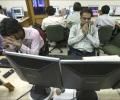
Most of the 30-Sensex constituents led by M&M, Adani Ports, BhartiAirtel, Bajaj Auto, Hero MotoCorp, ICICI Bank, Sun Pharma, Cipla, HDFC Ltd, ONGC and Hind Unilever were trading in negative terrain, falling by up to 5.77 per cent.

Crisil Research expects retail inflation to rise 60 basis points to 4 per cent this fiscal from 3.4 per cent in 2018-19.

The index rising for the fourth straight session surged 564 points.

The broader NSE Nifty, after shuttling between 10,600.25 and 10,491.45 points, ended the last session of Samvat 2074 with a rise of 6 points, or 0.06 per cent, to end at 10,530.
Exactly a fortnight ahead of the Reserve Bank of India's (RBI's) next monetary policy review, a key market indicator of interest rates - the overnight indexed swap (OIS) - suggests that the central bank may tighten policy by 35 basis points and then refrain from further rate hikes. RBI Deputy Governor Michael Patra recently described the OIS as the primary instrument for hedging interest rate risk in India. The six-member Monetary Policy Committee (MPC) of the RBI will meet on December 5-7.

The 50-share NSE Nifty ended flat, up 5.80 points, or 0.06 per cent, at 10,308.95.

The 30-share Sensex gained 321 points to end at 26,430 and the 50-share Nifty surged 100 points to end at 7,879.

The rupee had gained five paise to close at 63.25 against the dollar in on Monday's trade on fresh selling of the US currency by exporters amid bullish stocks.

Strong gains in metal, energy, auto and power shares lifted the key indices to new highs.

'The Modi government needs some big private sector trophies to affirm its anti-corruption credentials before the polls.' 'So on whose neck will the sword fall next?' 'To that extent, the outing of the ICICI Bank-Videocon story is cathartic,' says Shekhar Gupta.

From the 30-share basket, 28 scrips suffered losses. Over 200 stocks were at their 52-week low in Tuesday's trade.

Sensex gained nearly 0.4% or 96 points at 26087 level while Nifty ended up by 42 points or 0.5% at 7,791.40 level.

The 30-share Sensex ended 271 points higher to end at 28,930 and the 50-share Nifty climbed 76 points to close at 8,776.

According to the foreign brokerage major, after two quarters of 'near-zero' growth aggregate headline profit for Sensex companies, it is expected to show a weak recovery.

00 hours. The overall investors' wealth, measured in terms of valuation of all listed stocks, was down by nearly Rs 6 lakh crore in early morning trade, from nearly Rs 111.44 lakh crore at the end of Tuesday's trade.

Both the indices closed at five-month highs, led by financial services, IT and metal stocks, amid persistent foreign fund inflows.

Investors became richer by over Rs 6.34 lakh crore on Monday as markets gave a big shout-out to the Budget 2021-22, which analysts termed as 'unprecedented' against the backdrop of the pandemic-induced slowdown. Cheering the Budget proposals, the BSE benchmark Sensex zoomed 2,314.84 points or 5 per cent to close at 48,600.61. During the day, it jumped 2,478.63 points to 48,764.40. This was the best Budget-day gain for the markets since 1997, analysts said. Following the extremely positive market sentiment, the market capitalisation of BSE-listed companies rallied Rs 6,34,069.67 crore to Rs 1,92,46,713.70 crore.

The 30-share barometer started higher, but lost its way soon after the railway budget.

The benchmark BSE Sensex ended down 2.23 per cent. The Bank Nifty fell 3.59 per cent.
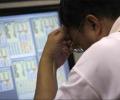
The BSE Sensex and Nifty fell more than 2 per cent on Tuesday, heading for their biggest daily loss since the midst of the rupee crisis in 2013

The BSE 30-share index after a positive opening stretched to 31,772.41, but could not stay there for long buffeted by the selling pressure. It hit a low of 31,562.25 before settling lower by 79.68 points, or 0.25 per cent, at 31,592.03.
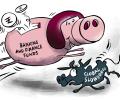
Invest only if you wish to go overweight on the sector.

'As our per capita income increases and various demographic segments emerge, the need for various kinds of protection and risk covers will become even more explicit.'
Reliance Industries, Infosys and Tata Motors were the top contributors
After paring some gains, the 30-share index settled at an all-time closing high of 28,008.90, up by 98.84 points, or 0.35 per cent, over the previous close.
Out of the 30-share Sensex pack, 21 ended lower and one remained unchanged
